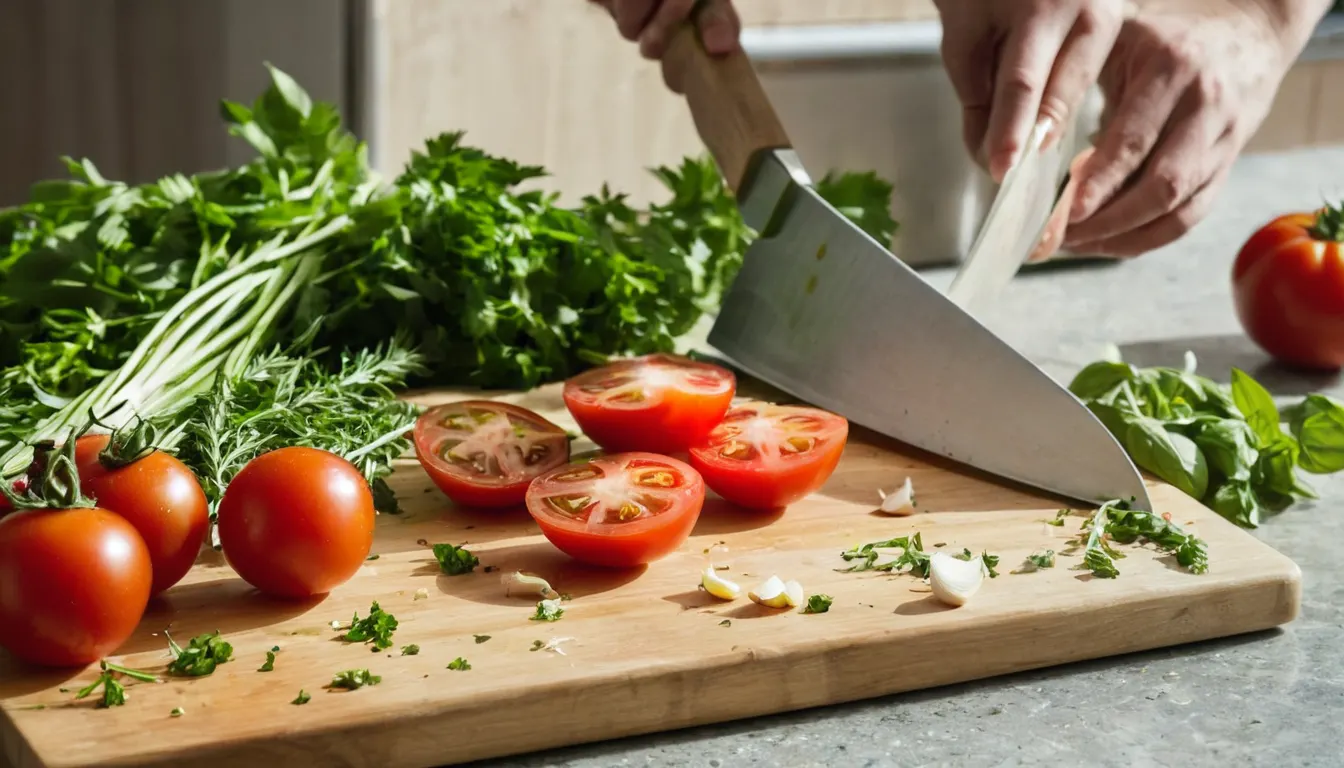
The three knives you need
- Chef's knife, 20 cm (8 in). Does nine jobs out of ten: chopping, slicing, dicing and mincing.
- Paring knife. A short blade for peeling, trimming and small, careful work.
- Serrated knife. For bread and soft-skinned tomatoes, where a straight edge would squash rather than cut.
Set up your board
Use a large wooden or plastic board. Put a damp cloth or piece of kitchen paper underneath so it cannot slide. Keep a separate board, or wash the board well with hot soapy water, after cutting raw meat. See the food safety guide.
How to hold the knife
Use the pinch grip: pinch the blade just in front of the handle between your thumb and the side of your bent index finger, then wrap your other three fingers around the handle. It feels odd at first but gives far more control than holding the handle alone.
The claw: protect your other hand
Curl the fingertips of the hand holding the food so your knuckles face the blade and your fingertips are tucked behind them. The flat of the knife rests against your knuckles as you cut. Move the claw back a little after each slice. With the tips tucked away, the blade has nothing to catch.
Common cuts and sizes
| Cut | Size | Used for |
|---|---|---|
| Mince | As fine as you can get it | Garlic, ginger, herbs for sauces |
| Small dice | About 6 mm (¼ in) | Onions for sauces, soups and risotto |
| Medium dice | About 12 mm (½ in) | Soup vegetables, salads |
| Large dice or chunks | 2 cm (¾ in) or more | Roasting vegetables, stews |
| Julienne | Matchsticks about 3 mm (⅛ in) thick | Stir-fries, slaws |
| Chiffonade | Thin ribbons | Basil and other soft leaves |
Even sizes matter more than exact ones. Pieces of the same size cook at the same rate.
How to dice an onion
- Cut the onion in half from root to tip. Peel off the skin and leave the root end on; it holds the layers together.
- Lay one half flat. Make vertical cuts from near the root to the tip, without cutting through the root.
- Turn the onion and slice across those cuts. The onion falls into dice. Discard the root.
Closer cuts give a smaller dice. A horizontal cut or two through the middle is optional; many cooks skip it.
How to mince garlic
Lay the flat of the knife on a clove and press firmly with the heel of your hand to crack it. The skin then slips off. Slice the clove thinly, then rock the knife back and forth over the slices, gathering them into a pile, until the pieces are fine.
Sharpening and honing
- Honing with a steel realigns the edge. Do it every few uses.
- Sharpening with a whetstone or pull-through sharpener removes metal to make a new edge. Most home knives need it a few times a year.
A sharp knife is safer than a blunt one. It goes where you aim it instead of slipping off a tomato skin or onion layer.
Care and safety
- Wash knives by hand and dry them straight away. Dishwashers dull edges.
- Never leave a knife in a sink of soapy water where someone could reach in.
- If a knife falls, step back and let it drop.